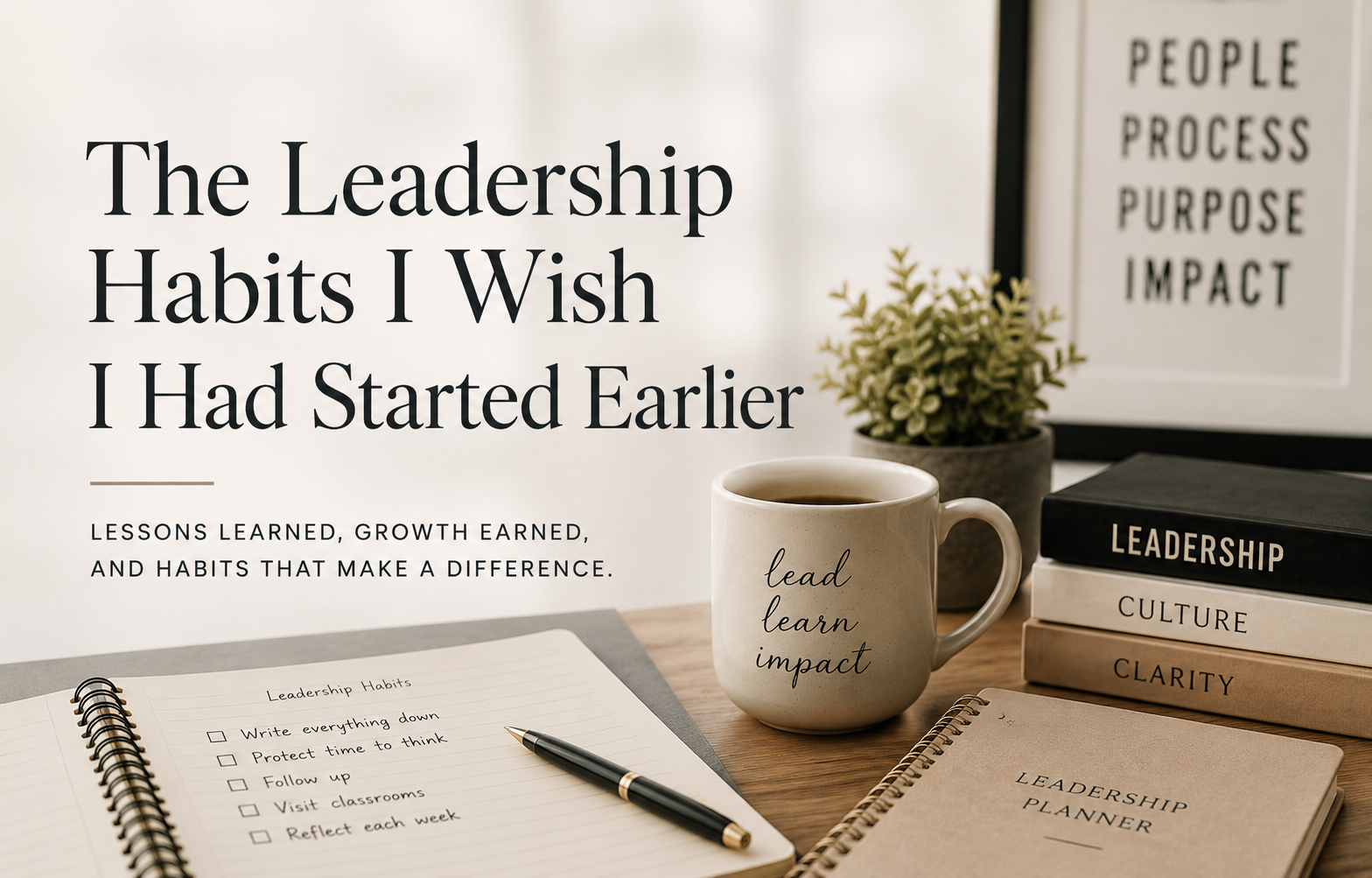
The Leadership Habits I Wish I Had Started Earlier
The Leadership Habits I Wish I Had Started Earlier
When I accepted my first assistant principal position, I spent a lot of time preparing.
I read books. I listened to podcasts. I talked with experienced administrators. I wanted to walk into the school year as prepared as possible.
Some of that advice was incredibly helpful.
But after finishing my first year, I’ve realized there were lessons I couldn’t have learned until I was actually doing the job.
Being an assistant principal is unlike anything I had experienced before. Even after 21 years in education—17 as a classroom teacher and 4 as an instructional coach—the transition challenged me in ways I didn’t expect. The work is rewarding, but it’s also mentally demanding. Every day requires you to shift between instructional leadership, student support, teacher coaching, parent communication, operations, and countless unexpected situations.
Looking back, I don’t wish someone had given me another leadership book.
I wish someone had talked to me about habits.
Not because habits solve every problem, but because they shape how you respond to the problems that inevitably come.
As I prepare for my second year, these are the habits I’m intentionally building. If you’re about to begin your first year as an assistant principal, I hope they’ll help you start a little stronger than I did.
Write Everything Down
If I could only give one piece of advice to a brand-new assistant principal, this would probably be it.
Write everything down.
That sounds simple, but I underestimated just how much information flows through an administrator every single day.
As a teacher, I had systems that worked. My responsibilities centered around my classroom. I knew my students, my curriculum, and my daily routines. There was certainly a lot to manage, but it felt familiar.
As an assistant principal, the amount of information I processed increased almost overnight.
A teacher asks you to stop by during planning.
A parent leaves a voicemail.
A counselor updates you about a student.
A coach asks about transportation.
Someone reminds you about a meeting next week.
Another teacher shares an idea they want your feedback on.
A student needs a follow-up conversation before the end of the day.
None of those things are difficult by themselves. The challenge is that they never stop coming.
During my first year, I realized I was spending too much mental energy trying to remember everything. Even when I remembered most of it, I constantly wondered what I might be forgetting.
That feeling creates unnecessary stress.
Looking back, I don’t think organization is really about being organized. It’s about protecting your attention. Every reminder you don’t have to carry in your head creates space to think more clearly, listen more carefully, and be more present with the people you’re serving.
If I could start over, I wouldn’t rely on sticky notes, random scraps of paper, or hoping I’d remember later. I’d choose one trusted system and commit to using it consistently.
Leadership asks us to make hundreds of decisions each day.
Your brain should be making decisions—not trying to remember them.
Protect Time to Think
One of the biggest surprises during my first year was realizing how easy it is to confuse being busy with being effective.
There is always something that needs your attention.
Students.
Parents.
Teachers.
Emails.
Meetings.
Discipline.
Phone calls.
By the time one issue is resolved, another one is already waiting.
It’s easy to spend an entire day working hard and still feel like you never got to the work that mattered most. The reality is that leadership requires something our calendars rarely give us naturally: time to think.
Thinking isn’t wasted time.
It’s where we identify patterns instead of reacting to isolated problems.
It’s where we prepare for difficult conversations instead of walking into them unprepared.
It’s where we improve systems instead of constantly fixing the same issues.
One thing I learned this year is that thoughtful leadership doesn’t happen accidentally.
It has to be protected.
As I prepare for year two, I want to be more intentional about creating space to think, reflect, and plan—not because I want fewer responsibilities, but because I want to lead those responsibilities better. Sometimes the most productive thirty minutes of your day aren’t spent answering emails.
They’re spent asking yourself what really needs your attention.
Be Visible in Classrooms
One of the reasons I became an assistant principal was because I love teaching and learning.
Ironically, it’s also one of the easiest parts of the job to lose sight of.
There were days when I handled discipline, attended meetings, answered emails, returned parent phone calls, and worked through operational tasks only to realize I had barely stepped into a classroom.
That bothered me. Not because I needed more walkthrough data. Because classrooms are where the real work happens.
Every decision we make as school leaders should ultimately improve what happens between teachers and students.
If we’re disconnected from classrooms, it’s easy to become disconnected from our purpose.
Some of my favorite moments this year happened during quick classroom visits.
Watching students collaborate.
Seeing a teacher try a new strategy.
Stopping to celebrate something that was going well.
Those moments reminded me why the behind-the-scenes work matters.
If you’re a new assistant principal, don’t let your office become your headquarters. Your presence in classrooms builds relationships, gives you context for coaching conversations, and keeps teaching and learning at the center of your leadership.
Follow Up Every Time You Say You Will
One lesson I learned this year is that leadership doesn’t end when the conversation does.
It continues with the follow-up.
When a teacher shares a concern…
When a parent asks a question…
When a student needs another conversation…
When you promise to look into something…
People notice whether you come back.
During my first year, I began to realize that follow-up is one of the simplest ways to build trust.
It communicates reliability.
It shows people they were heard.
It tells them they weren’t just another item on your to-do list.
Following up doesn’t always require a long meeting.
Sometimes it’s a quick email.
Sometimes it’s stopping by a classroom.
Sometimes it’s simply asking, “How did that go?”
Those small moments matter more than we often realize. I’ve learned that credibility isn’t built through one great conversation. It’s built through consistently doing what you said you would do.
Make Reflection Part of Your Leadership Routine
When the school year is in full swing, there isn’t much time to stop and think.
There’s always another deadline.
Another meeting.
Another challenge waiting around the corner.
One thing I’m grateful for this summer is the opportunity to reflect on my first year.
Not to dwell on mistakes.
Not to criticize myself.
But to learn.
Reflection has helped me recognize habits I want to change, strengths I want to build on, and areas where I still have a lot to learn.
Without taking time to reflect, it’s easy to repeat the same year over and over.
Experience alone doesn’t make us better leaders.
Learning from our experiences does.
As I head into my second year, I don’t want to simply have another year of experience.
I want to become a better leader because I intentionally learned from my first one.
Final Thoughts
If there’s one thing my first year taught me, it’s that leadership isn’t built during the big moments everyone sees.
It’s built in the quiet choices we make every day.
The systems we create.
The conversations we follow up on.
The time we protect for thinking.
The classrooms we choose to visit.
The moments we pause to reflect before moving on to the next challenge.
I don’t share these habits because I’ve mastered them.
Quite the opposite.
I share them because these are the habits I’m intentionally carrying into my second year.
If you’re preparing for your first year as an assistant principal, I hope this encourages you.
You won’t have every answer.
You won’t get everything right.
None of us do.
But if you focus on building strong habits instead of chasing perfection, you’ll give yourself a foundation that will continue to serve you long after your first year is over.
And if you’re anything like me, you’ll probably look back next summer with a new list of lessons—and that’s a good thing.
Because the best leaders never stop learning.